In this post, we’ll explore:
- Why understanding your nervous system matters and how this knowledge can change the way you relate to yourself
- Five steps to begin reconnecting with yourself through your nervous system and how to go about them
- Why this work isn’t about fixing yourself, but about developing a deeper relationship with your body and gradually coming home to yourself
In my previous article, Nervous System Basics: What Everyone Should Know About Their Nervous System, we explored how the nervous system works, what dysregulation can look like, and how experiences such as chronic stress, trauma, and overwhelm can shape the ways we move through life.
Understanding these patterns can be deeply relieving. What once felt like a personal failing may begin to make sense as your nervous system doing what it learned to do to protect you. But understanding is only the beginning.
So this next part is more experiential.
It’s about slowly learning to listen to your body, recognize what your nervous system is communicating, notice moments of safety, and discover what helps you come back into connection with yourself.
So, if the first article was about understanding your nervous system, this one is about beginning to use that understanding in your everyday life.
There is no perfect order to these steps, and there is no finish line. Think of them as invitations to explore, at your own pace, as your capacity allows.
Why the knowledge about the nervous system matters so much
You might be asking yourself: „Okay, I’ve learned a bit about the nervous system – but why does it actually matter?“
Because chronic dysregulation can prevent authentic living in alignment with ourselves and our truth.
Because in these dysregulated states, we never really settle. We’re never really present with ourselves and others. And we are so often disconnected from what we truly want and need.
And from there, so much becomes difficult:
- Being present in the moment – we’re caught either in the past or worrying about the future
- Being authentic – we can’t show who we really are
- Making clear decisions – we’re not enough in our body to feel what we truly need, and the part of our brain capable of clear thinking is practically „offline“ in a dysregulated state
- Showing ourselves as we are – vulnerability and being ourselves can feel dangerous
- Forming real connections – closeness and authentic self-expression can feel threatening
- Regulating our emotions – we swing between overwhelm and numbness and/or can be very erratic and irritable. We can oscillate between suppressing our feelings and letting them explode out.
The good news: you can learn to understand your nervous system
You can learn to observe:
- When am I activated (sympathetic)?
- When am I in freeze (dorsal vagal)?
- When do I actually feel safe (ventral vagal)?
Some first steps you can take
The first step: Awareness of nervous system states
The first step is always: awareness. Without judgment, simply noticing.
Not: „Oh no, dysregulated again, I’m so broken.“
But rather: „Ah, my nervous system is in fight mode right now. Interesting. What do I actually need right now?“
This self-awareness and mindfulness are an important foundation for everything that follows.
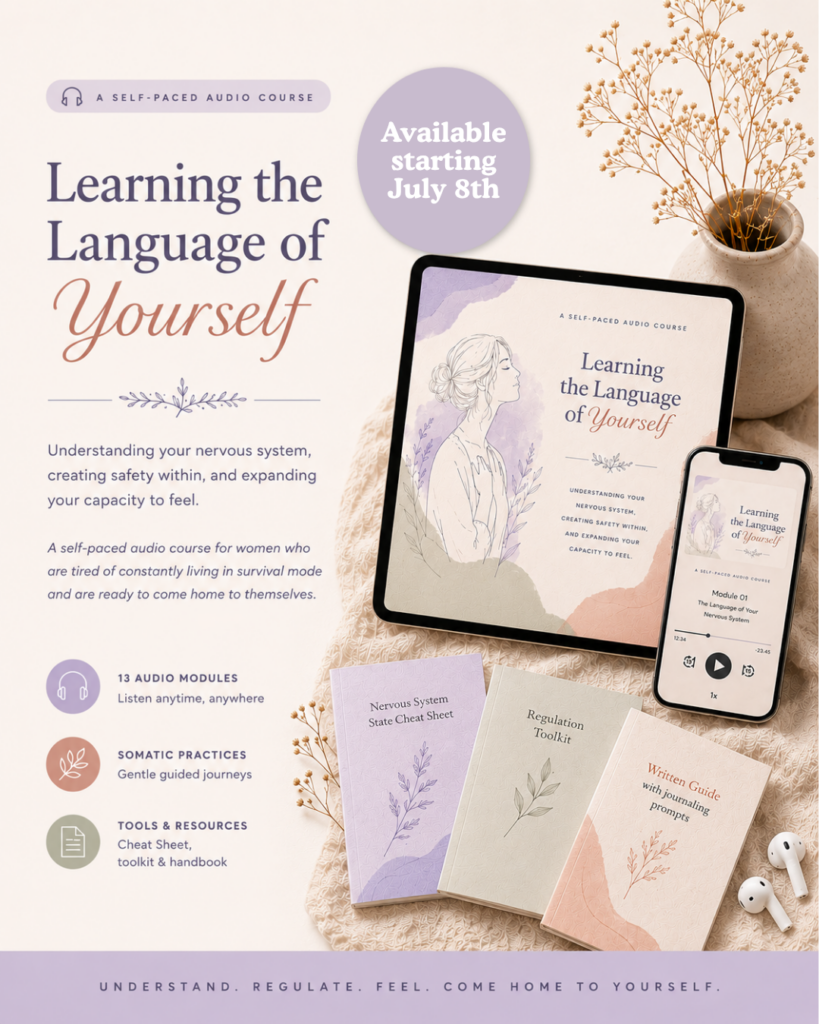
💡 This step includes learning the fundamentals of how the nervous system works. If you’d like to learn more about how to recognize different states and how regulation and capacity are connected, my audio course ’Learning the Language of Yourself’ is designed as a gentle starting point. It combines nervous system education with reflection and simple somatic practices to help you begin developing this relationship with yourself.
The second step: Listening to your body
Then it’s about looking, step by step: What is my body trying to tell me?
Your nervous system is constantly communicating with you. Through:
- Body sensations
- Emotions
- Reactions
- Behaviors
When we learn to understand these signals instead of suppressing or ignoring them, a whole new path opens up.
The third step: Learning to notice safety
Sometimes we’re so focused on our dysregulated nervous system state that we lose the ability to also notice the pleasant feelings, sensations, and moments.
I remember a time when I was very focused on my panic and inner restlessness and wanted nothing more than to „get rid of it“ and „regulate it away“ – and through that, I sank even deeper into dysregulation.
What helped me enormously was simply beginning to notice that I was, in fact, experiencing moments of ease again and again. I just hadn’t been paying attention to them.
Rebuilding our capacity to feel can begin with these small, pleasant experiences. A moment of warmth. The feeling of being supported. A deep breath that feels good. A sense of connection. The feeling of your feet on the ground.
These moments give your nervous system opportunities to learn that feeling your body and experiencing emotions does not automatically mean danger.
And from there, we can gradually begin to create more capacity for the full range of our experience.

The fourth step: Learning how to support and regulate your nervous system
As your awareness and capacity grow, you can begin to learn how to recognize what state your nervous system is in and what might support you in that moment.
This is about developing a relationship with your nervous system.
Learning to notice:
- When am I becoming activated?
- When am I beginning to shut down?
- What does my body need right now?
- What helps me feel more grounded or connected?
- When do I need movement, rest, connection, space, or simply to be with what I’m feeling?
Over time, this can help you become more familiar with your nervous system and develop more flexibility in moving between different states.
The fifth step: Going deeper with support
In my experience, sometimes there comes a point where understanding your nervous system and learning regulation tools isn’t quite enough.
As we build more capacity, we may begin to notice feelings, needs, or protective patterns that we’ve had to suppress, disconnect from, or move away from in order to keep going.
This doesn’t mean that we need to go back into painful experiences or relive the past. In fact, my work generally stays grounded in what is happening here and now, in your body and your present-day experience.
But when something deeper begins to emerge, having the right support can make a meaningful difference.
This is one of the reasons I believe in trauma-informed professional guidance. You don’t have to navigate everything that comes up on your own. Working with a trauma-informed somatic coach can give you a space to slow down, stay connected to your body, and gradually build the capacity to be with more of your experience without becoming overwhelmed.
For some people, that might mean working with a somatic practitioner. For others, therapy or another form of professional support may be more appropriate. And sometimes, these forms of support can complement one another.
💡 If you’d like to explore what this could look like for you, I offer trauma-informed somatic coaching for women and mothers who want to move beyond survival mode and feel more alive again. Through my guidance, I help you better understand your nervous system, expand your capacity, and reconnect with yourself – gently, sustainably, and at a pace that honors your body. Find out more here.
Nervous System Work: A Path of Integration
Nervous system work isn’t a quick fix – and it’s not about learning to stay „regulated“ all the time either. It’s a path. A process. A practice of learning your body’s language.
It’s less about training yourself to be calm no matter what, and more about building flexibility – the capacity to actually feel what’s happening in your body, to move between states without getting stuck, and to understand what your nervous system is communicating to you, rather than trying to override or „fix“ it.
So, in essence, it’s not about becoming more ‘regulated’.
It’s about becoming more alive and more authentically you.
Especially when your nervous system has been shaped by early trauma, chronic stress, or difficult life circumstances, this takes time, patience, and ideally professional support. But it’s possible.
What can help you
Along this path, various elements can support you:
- Psychoeducation (like this article or my audio course ‘Learning the Language of Yourself’) – understanding what’s happening in your system
- Body-centered practices – somatic exercises, breathing practices, dance…
- Trauma-informed guidance – professional support for deeper processes
- Mindfulness – arriving in the present moment and consciously practicing presence
- Co-regulation – healing relationships with people around whom you feel safe
- Expressive writing and art as self-expression – an important pillar for me personally on this path, as a way to give feelings expression
If you’d like guided support to explore some of this in your own time, my audio course Learning the Language of Yourself walks you through this step by step at your own pace, with a companion handbook alongside it.
How I can support you
In my work as a trauma-informed guide and somatic coach, I accompany people exactly on this path.
We work:
- Body-centered – not only through the mind, but through the wisdom of the body
- Nervous-system-oriented – with your nervous system as a guide
- Trauma-informed – at your pace, with room for everything that’s present
- Resource-oriented – we build safety before we go deeper
My goal is to support you in feeling safe within yourself again. Step by step. With patience, compassion, and trust.
If you feel ready to go deeper with dedicated 1:1 guidance rather than working through this alone, that’s something we can explore together in individual sessions.
Your next step
If you recognize yourself in this article and feel: „Yes, this is exactly what I need“ – then feel free to email me or book a discovery call below.
I offer a free initial conversation (20-30 min) where we look together at:
- Whether working with me is the right fit for you
- Where you currently stand
- What you need
In closing: You are not „broken“
Sometimes we might feel like something is „wrong“ with us.
But let me leave you with one thing:
Even if your nervous system is dysregulated – it is not broken. It’s functioning exactly as it learned to function. To protect you. To secure your survival.
Your nervous system did and is doing its best with the resources it had available.
And now – now you can offer it new experiences. Show it, little by little: it’s okay. The danger has passed. You are safe.
It takes time. It takes patience. It takes compassion.
But it’s possible.
I truly hope this article has helped you understand your nervous system a little better. And that maybe this can be the beginning of something new for you.
You are not alone on this path. 💛
If you’d like to learn more about my work or have questions: feel free to message me or take a look around my website. I’d love to hear from you.
Important note: My work doesn’t replace psychotherapy. If you are experiencing acute or severe psychological distress, I recommend working with a therapist – alongside or instead of our work together. I’m happy to refer you if needed.

This blog post was written with love for everyone who wants to find their way back to themselves and their essence. Feel free to share it with people you care about who might benefit from it. So glad you’re here. ♥️
More about me: As a trauma-informed somatic coach, I’m here to support you on your path to greater self-connection and realization. With my support I help you get there – body-centered and nervous-system-oriented. Find out more about working with me here.
💡 Want to take this understanding further?
Understanding your nervous system is a powerful first step. My audio course Learning the Language of Yourself offers a gentle introduction to recognizing your nervous system states, understanding what your body is communicating, and beginning to build more capacity.