
What you’ll learn in this article
After reading this article you’ll understand:
- what the nervous system actually does
- what a dysregulated nervous system is
- why you’re not „broken“
- what fight, flight and freeze really mean
- why regulation isn’t about always feeling calm
Maybe you’ve noticed over the past few years how much talk there has been around the nervous system. On Instagram, in podcasts, in coaching offers. And that’s a good thing – because understanding how our nervous system works can genuinely be life-changing.
At the same time, this also creates misunderstandings and generalizations. Some things get oversimplified or misunderstood. That’s why I want to share some of the most important nervous system basics with you in this article – the foundations that have personally helped me the most, and the ones I encounter again and again in my work as a trauma-informed somatic coach.
The biggest misunderstanding about a healthy nervous system
Let me start with probably the biggest misunderstanding I hear over and over:
„A healthy nervous system means always being calm and relaxed.“
That’s not true. And it’s important to understand this, because this assumption can put us under enormous pressure.
What a healthy nervous system actually means
A healthy nervous system does not mean staying permanently in a state of safety and connection. It doesn’t mean never being stressed, agitated, or afraid.
A healthy nervous system is allowed to become activated. It’s allowed to react. It’s allowed to go into fight-or-flight mode – that’s actually important and completely normal. The crucial difference lies in what happens afterward.
An everyday example
Imagine this: you’re outside in the evening. It’s dark, and suddenly there’s a loud rustling in the bushes next to you.
What happens? Your system switches into alert mode immediately and completely automatically:
- Your heart rate speeds up
- Your senses sharpen
- Your body mobilizes energy to flee or fight
- You’re wide awake and focused
This is the sympathetic state – your nervous system in fight-or-flight mode. Typical feelings in this state: anger, irritation, panic, fear, worry, frustration. Then you realize: „Ah, that was just the wind in the bushes.“ The danger has passed.
And now comes the crucial moment:
Your nervous system winds back down. You return to the parasympathetic state – the ventral vagal state. The state of safety, connection, and calm.
This is a healthy, self-regulating nervous system. It reacts to danger – and it finds its way back to safety.
The reason for this lies in how our system works – and where our deepest conditioning is actually stored.
What does „dysregulation“ mean?
Dysregulation looks a bit different – and many of us live with it daily without noticing.
When the system doesn’t return to ‘center’
Dysregulation means: you enter this activated, tense state – and you don’t come back out of it.
You stay in this state of alert. You feel unsafe. You’re hypervigilant – constantly on guard. This can last for hours – or longer.
Your nervous system doesn’t find its way back from activation into a state of safety. Even though you rationally know the danger has long since passed. This is a sign of a dysregulated nervous system. Because even when the rational, thinking part of your brain – your prefrontal cortex – knows it, your brainstem, the oldest part of your brain, is still in danger mode.
The Window of Tolerance
An important concept for understanding dysregulation is the window of tolerance.
Imagine there’s a range – your personal window – within which you can handle stress without becoming dysregulated. Within this window, you can:
- Think clearly
- Respond appropriately
- Self-regulate
- Be present
We are often dysregulated when our window of tolerance is very small.
This means: it only takes what (to our minds) seems like a „small thing“ – a critical comment, an unexpected change, a sound – and we land in fight-or-flight mode and struggle to find our way back out, or can’t at all.
The freeze state: when the system shuts down
There’s another form of dysregulation that many of us don’t recognize as such: the freeze state.
When the activation becomes too much
When the activation becomes too great and your system can no longer hold it, something remarkable happens: it simply shuts down. It „freezes.“ This is called freeze – governed by the dorsal vagus.
It’s like when animals feign death if danger arises. An evolutionarily ancient survival strategy: when fighting and fleeing are no longer possible, all that’s left is freezing.
Why we often don’t recognize freeze
Most of us don’t recognize when we enter this state. We dissociate – become as if split off from our body. Emotionally numb. Frozen inside.
For our nervous system, this state means „life-threatening danger.“ Energy is conserved – for the purpose of survival.
Typical feelings in the dorsal vagal state: shame, hopelessness, depression, emotional numbness, emptiness.
So, imagine you feeling numb, disconnected from your body, your breath becomes really shallow, almost as if your breath has stopped and maybe you stare off into nothingness – these are signs of the freeze or shutdown state.

Moving Between States: Fight, Flight, and Freeze
A dysregulated or traumatized nervous system often shows itself by us moving between these two states: fight/flight and freeze. Between „I have to function“ and „I can’t anymore.“
The tricky part: we’re often not even aware of it, because it’s become so normal to function this way. It’s our „normal“ – even if it’s anything but healthy.
Functional freeze: functioning in survival mode
There’s another state I want to mention, because it’s so common and yet so little known: functional freeze.
When survival looks like functioning
Maybe you know this: you function in daily life. You get things done. You somehow manage. From the outside, everything looks normal.
But internally? You feel cut off from your body. Emotionally numb. Tired and exhausted, even though you may still be physically active. These are signs of functional freeze – a mixed state between activation and freezing.
Many of us have learned to go through life exactly this way. It looks unremarkable from the outside, even productive. But internally, we’re in survival mode. Dissociated from our own body. Disconnected from our real feelings and needs.
It’s a form of high-functioning dissociation – and it’s exhausting on a deep, existential level.
Fawning: When We Suppress Ourselves to Maintain Connection
Maybe you know this one too: you say yes when you mean no. You apologize for things that aren’t your fault. You scan a room the moment you walk in, already sensing what everyone else needs before you’ve even noticed what you need. Saying no, taking up space, or disappointing someone feels almost unbearable.
This is fawning – and it also counts as a nervous system state, alongside fight, flight, and freeze.
An appeasement response
Fawning is an appeasement response. Somewhere along the way, your system learned that making others comfortable and taking care of their needs was the safest available strategy – safer than conflict, disappointing someone or being truly seen.
This can look like disconnecting from our own bodies and our own needs, in order to fulfill other people’s needs, wants, and expectations instead. Over time, we can lose touch with our own „yes“ and „no“ – with what we actually want, feel, or need, because we’ve spent so much energy attuned to everyone else.
I’ll be sharing more on these two mixed states – Functional Freeze and Fawning – soon.
How These Patterns Develop
You might be wondering now: „Why is my nervous system dysregulated in the first place? How does this happen?“ Here’s a brief explanation for what is quite a comprehensive topic.
The role of trauma
Your nervous system has learned to function the way it does because of certain experiences. Trauma often plays a central role here. And this includes not only trauma from major, singular events – accidents, violence, disasters (i.e. shock trauma) – but also so-called attachment and developmental trauma.
Trauma isn’t simply what happened to us – it’s what happens in our nervous system when an experience was too much, too sudden, or too overwhelming for us to process and integrate, especially when we didn’t have someone by our side to be with us, help us co-regulate, and make space for what we were feeling.
And this is part of why trauma is so individual. The same experience can affect one person very differently from another, depending on how it was experienced, what resources were available at the time, and how the experience was processed and stored in the nervous system.
Many of us carry attachment and developmental trauma within us. This doesn’t come from one single, dramatic event, but rather from:
- Lack of emotional availability from caregivers
- Feelings that weren’t allowed to exist
- Too little co-regulation in stressful moments
- The feeling of not being seen or understood
- Being overwhelmed in childhood without adequate support
💡 If you’d like to learn more about trauma and its different forms, you can find a detailed article here.
What the nervous system learns through early conditioning
Especially in early childhood, our nervous system is extremely malleable.
Over time, experiences like these can shape the way our nervous system anticipates and responds to the world. One message it may learn is:
„I am not safe.”
This might show up as an underlying expectation that:
- The world is dangerous.
- My body is not safe.
- I am alone with what I feel.
- No one is there to help me.
- I have to stay on guard.
These expectations aren’t necessarily conscious beliefs. They can show up through automatic reactions, bodily sensations, emotions, or patterns of behavior. And these are imprints that we often carry with us – unconsciously – into adulthood.
The nervous system can continue responding in these patterns shaped by past experiences, even when the original danger is no longer present.
This is one reason you can consciously know, „I’m safe now,“ while still noticing that your body reacts as though something is wrong.
Chronic stress as a trigger
But a nervous system can also become dysregulated later in life – through chronic stress.
This can include:
- Long periods of being overwhelmed without recovery
- Ongoing stress at work or within the family
- Chronic illness and its burden
- Financial insecurity over an extended period
- Societal or systemic stress (e.g., discrimination, marginalization)
When our system remains under this ongoing stress for a long time, without truly being able to rest, the nervous system learns that danger is the normal state. The window of tolerance keeps shrinking. The dysregulation becomes chronic. This development is further reinforced by a traumatized nervous system.
If your nervous system is dysregulated, it’s not your fault.
Learning about your nervous system can change the way you see yourself. What once felt like a personal failure can begin to make sense as a protective response your system developed for a reason.
But understanding is only the beginning. The next question is: What can I actually do with this knowledge?
That’s where the work of reconnecting with your body, learning to recognize your needs, building capacity, and gradually finding your way back to yourself begins.
Read next: How to Begin Reconnecting With Yourself Through Your Nervous System
💡 Want to take this understanding further?
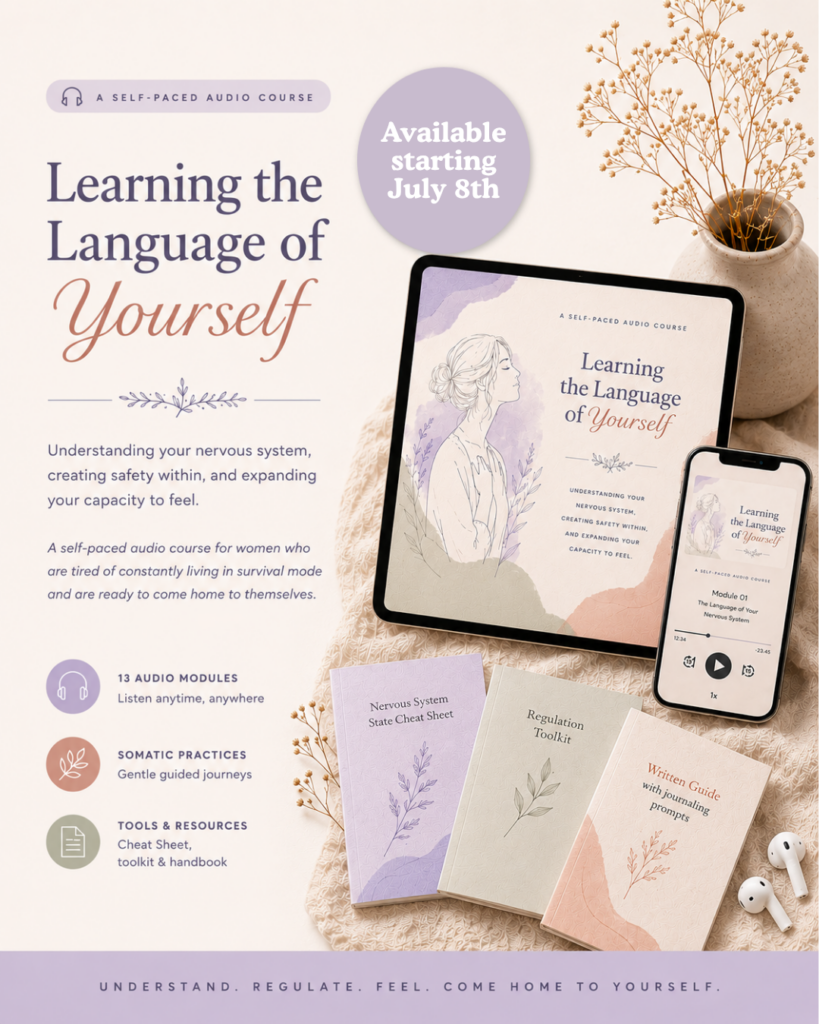
Understanding your nervous system is a powerful first step. My audio course Learning the Language of Yourself offers a gentle introduction to recognizing your nervous system states, understanding what your body is communicating, and beginning to build more capacity.
And if you’re ready for more personalized support, you can also explore my 1:1 trauma-informed somatic coaching here.
Important note: My work doesn’t replace psychotherapy. If you are experiencing acute or severe psychological distress, I recommend working with a therapist – alongside or instead of our work together. I’m happy to refer you if needed.

This blog post was written with love for everyone who wants to find their way back to themselves and their essence. Feel free to share it with people you care about who might benefit from it. So glad you’re here. ♥️
More about me: As a trauma-informed somatic coach, I’m here to support you on your path to greater self-connection and realization. With my support I help you get there – body-centered and nervous-system-oriented. Find out more about working with me here.